|
Link two (or more) entries together so that the total of all entries in a transaction is zero.
Luca Pacioli may well be to accountants what Galleio is to physicists. He was a franciscan monk who first described one of the core ideas of accountancy: double entry bookeeping. The idea behind double entry bookeeping is quite simple, every withdrawel must be balanced with a deposit. Thus everything you do to books has two elements, the subtraction from one account, and the addition to another. In this way money is conserved much like physicists conserve energy. For an accountant you cannot create money, it is only ever moved around.
How it Works
When we use transactions there are actually two kinds that you run into. A two-legged transaction only ever has two entries, which are of opposite sign. This is very literally a single movement from one account to another. A multi-legged transaction allows any number of entries, but with still the overall rule that all the entries must sum to zero, thus conserving money.
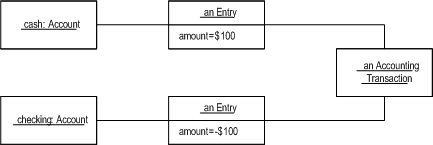
Figure 1: An example of a two legged transaction
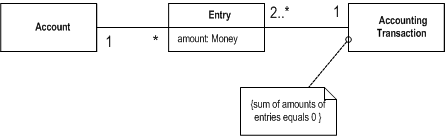
Figure 2: Class diagram for a multi-legged transaction, notice that the only difference is the multiplicity of the association: accounting transaction -> entry
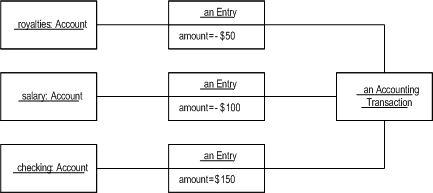
Figure 3: An example of a multi-legged transaction. This might represent a situation where I have two checks which I pay into my bank account with one deposit slip.
Two-legged transactions are the easiest to work with, so if that's the way the business works, it's not worth trying to build multi-legged transactions even though you can support a two legged transaction with a multi-legged transaction.
With a two-legged transaction the entries are optional - you can choose to have all the data on the transaction. This works if the two entries really are only different in the sign of their amount. When I lived in Britain it was always the case that it took three days to do a transfer from one account to another. So even if I transferred money from my checking (current) to my savings (deposit) account at the same branch, the withdrawel from my checking account would occur three days before the deposit to my savings account. In this case we would need the entries so we could record the separate dates.

Figure 4: A class diagram for an accounting transaction without entries
With a multi-legged transaction often the difficulty lies in how to create the transaction. A two-legged transaction can be created in one operation quite easily. However a multi-legged transaction takes a bit more effort. So it's worth using Proposed Object to build up a transaction before you post it propertly to the appropriate accounts.
|